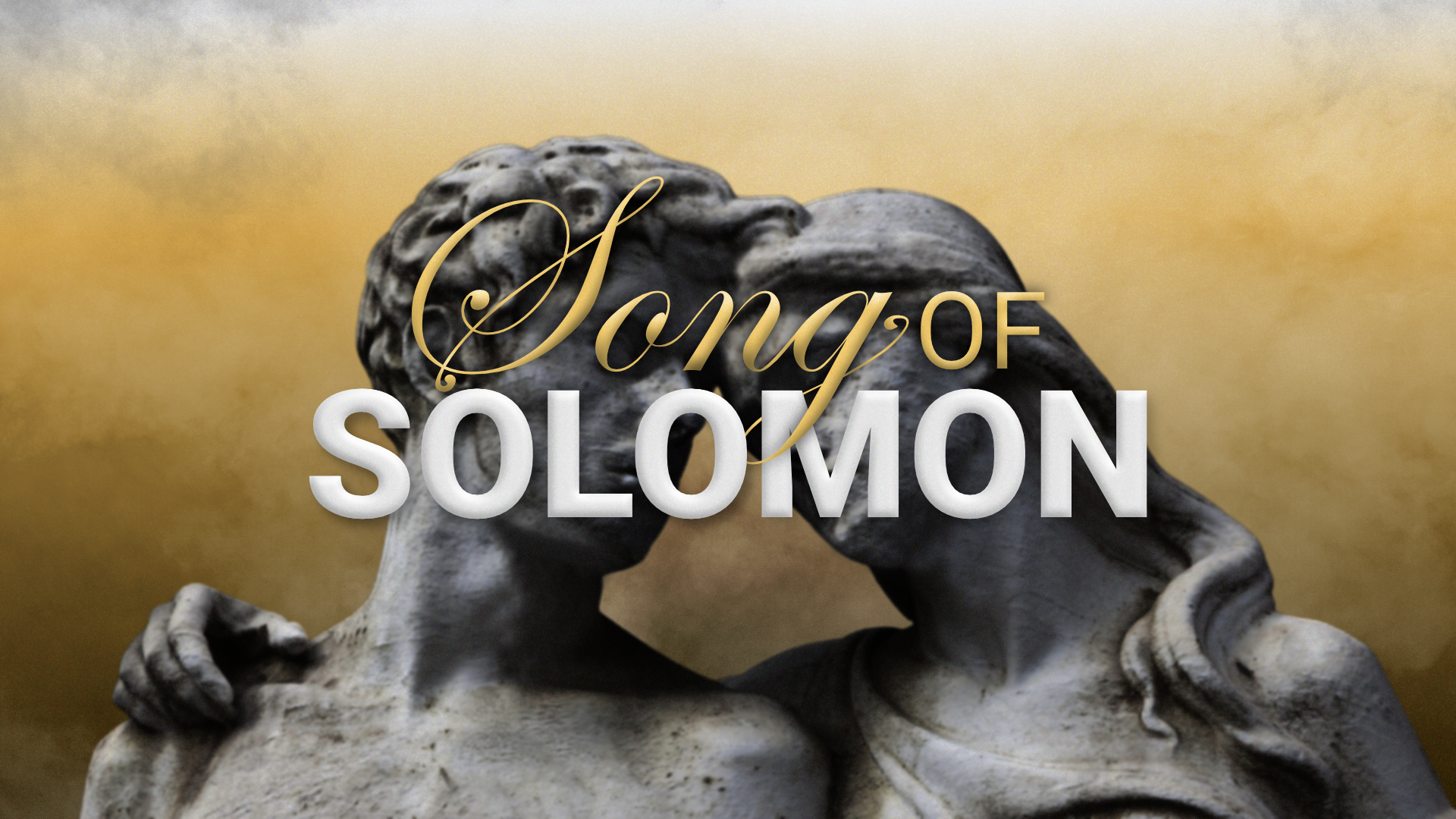
Intro to Song of Solomon: "God’s Book on Love, Sex, and Marriage”

Manuscript
Let’s take our Bibles together and turn to the Song of Solomon in the OT. The Song of Solomon: “God’s Book on Love, Sex, and Marriage.”
Why study the Song of Solomon? Why this book? Well, this is Scripture. There’s no real debate about that among serious students of the Bible. And for those of you who are committed to verse-by-verse exposition of Scripture, that’s enough for you.
But others might ask, “Yes, but why this book out of the sixty six books of the Bible? This is a hard book to interpret. And some portions of this book are a little racy.”
Well, here’s the answer. Throughout my entire adult life, I have been on a mission to study and celebrate the goodness of love, sex, and marriage as God has given them to us. I’ve done my best as a pastor and a teacher to live that out in my own life. I’ve done my best to communicate the goodness of love, sex, and marriage to multiple generations going back to my days as a youth pastor many years ago.
And yet, at the same time, the need for good, biblical teaching on this subject continues to be pressing in our world. It’s more pressing now than ever. The attack on God’s good gifts is greater than ever. The confusion surrounding this topic is greater than ever. And oftentimes (too often in fact) Christians get caught in the miry bog of sexual sin and sexual perversion. And they miss out on God’s best for their lives.
And the Bible is not silent on these things. And the strategy for keeping people out of that bog is two-pronged: 1) We graciously warn and instruct and challenge people about how sexual sin is defiance towards God and has devastating consequences for their lives. I have no problem as a pastor doing that. In fact, the Bible does that for us if we just teach it. But also, at the same time, 2) We show people the better way. We show them the supremacy of God’s good gifts for us.
And wouldn’t you know it—God wrote an entire book of the Bible that is an expression of that goodness. It’s not an easy book to read and understand. But it’s captivating. I’ve been captivated by it since I was a teenager.
And it’s not the only place in the Bible that God talks about the goodness of love, sex, and marriage. That’s a pretty common biblical theme. It goes all the way back to the Garden of Eden, where one man and one woman come together in holy matrimony with sanctified sex and biblical baby-making. That was the beginning, and it was glorious. That activity, that goodness goes all the way back to Genesis 1–2 and the beginning of humanity.
So, God’s Word talks about love, sex, and marriage in several places. But there’s only one book of the Bible that is uniquely dedicated to this subject. And we’re going to study it for the next few weeks.
And it doesn’t matter if you are male, female, married, single, divorced, or remarried... It doesn’t matter if you’re thirteen, thirty-three, fifty-three, or ninety-three... every single person in this room (no matter what demographic you are in) should be ready and willing to defend the goodness of love, sex, and marriage that God has created. And we all have something to learn from this book of the Bible—Song of Solomon.
----------------------------
So, let’s begin.
Today, I want to give you “Seven Preliminary Matters” concerning this book. Let’s start with this. Let’s start with the book’s name.
• 1) The Book’s Name: Song of Solomon (Hebrew: שִׁיר הַשִּׁירִים)
The book’s name is “The Song of Solomon” or “Song of Solomon” or “Song of Songs” as some English translations have it. The book is also called “Canticles” in some circles, but I’m going to avoid that term in this series.
In Hebrew, the name of the book is שִׁיר הַשִּׁירִים. The Hebrew שִׁיר (šîr) means “song,” so “Song of Songs.” That’s not a super creative title, really. It’s just the first two words in the book. That’s typically how the Hebrews titled their books.
The first verse of the book in Hebrew is as follows:
• שִׁ֥יר הַשִּׁירִ֖ים אֲשֶׁ֥ר לִשְׁלֹמֹֽה
1 The Song of Songs, which is Solomon’s.
Perhaps you can hear the alliteration already in this poetic book—the repeated “sh” sounds. That shouldn’t surprise us, because this is a book of poetry.
The phrase “song of songs” is a Hebraism meaning “the greatest of songs” or “the superlative song.” It’s similar to “the holy of holies” or “the king of kings” or “the lord of lords.”
The phrase “X of the Xs” means it’s the best of the best. If I could put it in modern parlance, it means “The G.O.A.T.—The Greatest Of All Time!” This Song of Songs was Solomon’s greatest song. It was the greatest song ever written. This song is to songs what Michael Jordan is to basketball players.
And then, just to give you a flavor of what this greatest song of all time is about, verse 2 says,
• 2 Let him kiss me with the kisses of his mouth! For your love is better than wine
Wow! Okay. This is not your typical book of the Bible. More on verse 2 next week.
----------------------------
Write this down as a second point in your notes. Here’s a second preliminary matter:
• 2) The Book’s Author: Solomon, king of Israel
Let me just remind you that Song of Solomon, like every book in the Bible, was co-written by the Holy Spirit. We know this from 2 Timothy 3:16:
• “All Scripture is God-breathed…” We know this from 2 Peter 1:21: “For no prophecy was ever produced by the will of man, but men spoke from God as they were carried along by the Holy Spirit.”
So, the book of Song of Solomon was co-authored—it was inspired by the Holy Spirit. The Holy Spirit carried along a certain person to write this book. Who was that person whom the Holy Spirit inspired?
Well, the answer to that is clearly stated here in the first verse.
• 1 The Song of Songs, which is Solomon’s.
Solomon wrote several books of the Bible including Proverbs and Ecclesiastes. He also wrote two psalms in the book of Psalms (Pss 72; 127). He was a prolific author. God gave him extraordinary powers, and he was famous for his wisdom.
It says in 1 Kings 4:32 that Solomon spoke 3,000 proverbs and wrote 1,005 songs. We have the book of Proverbs with many of his proverbs. And we have in Song of Solomon his magnum opus, if you will. This was his greatest hit—his greatest of 1,005 songs.
Now the Hebrew of verse 1 לִשְׁלֹמֹֽה can be translated “for Solomon” or “of Solomon.” So, some scholars have suggested that maybe another person wrote this book—someone in the Solomonic school perhaps. Or maybe someone wrote this “on behalf of” Solomon as a ghostwriter. Or maybe “for Solomon” as an ode to his literary gifts. I think that’s possible, but unlikely. I think this is a clear attribution in the first verse of the book. In other words, I think Solomon wrote this book himself.
And I realize that this second point trips up people sometimes. They think to themselves, “How could Solomon write a book about the goodness of love, sex, and marriage?” The reason people struggle with that is obvious. Solomon was a polygamist. And also, Solomon forsook the God of the Israelites.
1 Kings 11 says as follows. This is one of the saddest passages in the Bible.
• 1 Now King Solomon loved many foreign women, along with the daughter of Pharaoh: Moabite, Ammonite, Edomite, Sidonian, and Hittite women, 2 from the nations concerning which the Lord had said to the people of Israel, “You shall not enter into marriage with them, neither shall they with you, for surely they will turn away your heart after their gods.” Solomon clung to these in love. 3 He had 700 wives, who were princesses, and 300 concubines. And his wives turned away his heart.
4 For when Solomon was old his wives turned away his heart after other gods, and his heart was not wholly true to the Lord his God, as was the heart of David his father. 5 For Solomon went after Ashtoreth the goddess of the Sidonians, and after Milcom the abomination of the Ammonites. 6 So Solomon did what was evil in the sight of the Lord and did not wholly follow the Lord, as David his father had done. 7 Then Solomon built a high place for Chemosh the abomination of Moab, and for Molech the abomination of the Ammonites, on the mountain east of Jerusalem. 8 And so he did for all his foreign wives, who made offerings and sacrificed to their gods.
Solomon got off to a great start. He feared God and God blessed him with wisdom and with riches. But Solomon, like many of the kings of the OT, didn’t finish well. He’s a cautionary tale in many ways. I actually think there is a redemptive arc in the life of Solomon, but that doesn’t come until the very end of his life.
And when he wrote the Song of Solomon, he was not a young king who still feared the Lord. I used to think that about this book, but I don’t think that’s correct.
Here’s why I say that. Look at Song of Solomon 6:8 with me. It says there about Solomon’s court.
• 6:8 There are sixty queens and eighty concubines, and virgins without number.
These are not the 700 wives and 300 concubines of later, but you can see already that Solomon is building his harem. And there are also descriptions of Solomon’s wealth and elaborate entourage in the book. This was not Solomon at the beginning of his reign or before he became king. This was Solomon in mid-life.
So back to the objection some people might have, “How could this middle-aged, polygamous king, Solomon, write a book about the goodness of love, sex, and marriage?” Let me address that right now. Turn with me, if you would, to Ecclesiastes. It’s the book right before Song of Solomon in your English Bibles.
Ecclesiastes, like Song of Solomon, was written by Solomon later in life. It’s not the optimistic, cheery book of Proverbs. Instead, it’s the old, cynical king writing about the vapor-like existence of mankind.
And yet, Ecclesiastes 2:9 says as follows:
So I became great and surpassed all who were before me in Jerusalem.
This is Solomon talking about all of his wealth, and all of his riches, and all of his women. This is Solomon late in life after he had drifted far from God. He’s completely self-indulgent. He deprived himself of no pleasure. And he says it’s vanity of vanities. It’s vapor-like.
And yet, look at the end of verse 9.
• I became great and surpassed all who were before me in Jerusalem. Also my wisdom remained with me.
So, yes, Solomon became great. We know that from 1 Kings. And yes, King Solomon became a polygamous, Yahweh-angering apostate as he aged as the king of Israel. But mysteriously, his wisdom still stayed with him. God still gave him the power, by the Holy Spirit, to write on important subjects late in life, including love and marriage in Song of Solomon.
In fact, one of the things that we’ll find out in this book is that Solomon makes several cameos in his song. He shows up from time to time with much fanfare, but he’s not the main character of the book. The main character of the book is a woman.
I used to think that this book was a love poem between Solomon and his first love or his first wife. I’ve even taught that at Moody as a professor. But I’ve changed my view on this. I don’t think this is a love song celebrating Solomon and his first wife. Instead, it’s a love story about a shepherdess (a Shulamite) and her shepherd husband. And she, the Shulamite, chooses a better way than Solomon. And in that way, Solomon is presented in the book as the foil.
It’s as if Solomon is writing this song and saying, “Don’t do like me. That’s not to way to do it. Do like the Shulamite!” More on that in the days to come.
----------------------------
Write this down as a third point in your notes. Here’s a third preliminary matter:
• 3) The Book’s Genre: A song of Hebrew love poetry
And just to clarify, this song is one continuous song from chapter 1 to chapter 8. It’s not a mixed tape of Solomon’s greatest hits. It’s a cohesive whole. It’s got structure and repetition.
And like a lot of songs, it’s cryptic at times. It’s poetic at times. It’s hard to follow at times. It’s impressionistic at times. And yet, to the inquisitive mind who listens to it again and again and thinks about its message, that inquisitiveness is rewarded.
I brought with me today a short recording of part of chapter 1 of Song of Solomon. This is one Hebrew reader’s interpretation of how this song might’ve been sung 3,000 years ago.
Take a listen:https://mechon-mamre.org/mp3/t3001.mp3
For those of you who like romantic music, that’s not exactly smooth jazz. It’s possible that this song was sung and re-sung in different ways with different instruments over the centuries. And there’s a tradition that the Hebrews would read the Song of Solomon every year during Passover. If so, then many Hebrews probably knew the Song (or portions of the Song) by heart.
Perhaps this was a song sung at Hebrew weddings. Hebrew weddings could go on for days, so maybe this song was sung and performed by a group of singers over a period of time during the wedding. I don’t know.
I do want to point this out, though. This is a song, yes, but this is also a song of Hebrew love poetry. So typical poetic features are found in this book. There is parallelism. There is terseness (i.e., brevity of speech). There is also figurative imagery. And some of the figurative imagery in this song is confusing to modern readers. There are puzzling metaphors that don’t translate into our modern imaginations.
For example, the husband says of his wife, “Your belly is a heap of wheat” (Song 7:2). I’m guessing, men in the room, you’ve never said that about your wife.
At one point, the man describes his wife’s nose as the tower of Lebanon (Song 7:4). Men in the room, I would suggest you not use that figurative imagery with your wife. If that was a term of endearment for a woman 3,000 years ago, the significance of that and the sweetness of it has been lost to history.
In fact, I’ve seen several artistic depictions of a woman drawn with the language that the man uses in this book, and the depictions are... how do I say this? ... grotesque. There’s a really good one on the BibleProject video for Song of Solomon that is absolutely bizarre. I’m sure some of you could have a field day with that using AI. The point is that we shouldn’t torture this figurative language by taking it to a logical conclusion. It’s poetic language.
In a similar way, the woman says of the man that his cheeks are like “beds of spices” (Song 5:13). What in the world does that mean? We’ll get to it. She describes her husband’s eyes as doves bathed in milk (Song 5:12). She says that his arms are “rods of gold set with jewels” (Song 5:14). That doesn’t mean that he’s been hitting the weight room and sitting in a tanning bed. It means—here’s one sneak peek at what we’ll be doing in the Song of Solomon—she sees her husband as strong and valorous and valuable. More on that later.
And speaking of love poetry, let me just say too that in the ancient Hebrew world there wasn’t such a thing as the celebration of love poetry and romance outside of the context of marriage. So please don’t approach Song of Solomon as some kind of generic love song for any two people who have feelings for each other. This isn’t a top 40 pop song in our day. The woman in this story is referred to as a “bride” six times in the book (Song 4:8, 9, 10, 11, 12; 5:1). This isn’t a celebration of love and sex in the abstract. This is a celebration of love and sex as part of the marriage covenant. That’s just how the Hebrews thought.
----------------------------
Write this down as a fourth point in your notes. Here’s a fourth preliminary matter:
• 4) The Book’s Setting: Ancient Israel in the tenth century BC
I’ll touch on this quickly. Solomon ruled for forty years over Israel from approximately 970–930 BC. So, this fourth point is really just an affirmation of Solomonic authorship.
And let me just point out a few things in the text, because some have assumed that Song of Solomon was written years after Solomon. Or some have assumed that it was written by a non-Israelite because the language and imagery are too sexualized for a God-fearing Hebrew.
The problem with that is that there are geographical locations throughout the book that suggest a tenth-century BC setting. For example, Solomon mentions Jerusalem and En-gedi in the south. But he also mentions Tirzah, Gilead, Carmel, Lebanon, Hermon, Heshbon, and even Damascus in the north and northeast. And he does this without any apparent awareness of the later division between the northern and southern kingdoms. That didn’t come until Solomon’s death when his hapless son Rehoboam blew up the kingdom.
Especially interesting is Song of Solomon 6:4, where Tirzah and Jerusalem are mentioned side-by-side: “You are beautiful as Tirzah, my love, lovely as Jerusalem.” Tirzah would later become the capital of the northern kingdom, while Jerusalem was the capital of Judah. And Samaria, which replaced Tirzah as the northern capital in the ninth century BC, is never mentioned.
Also, when Solomon shows up in this book, it’s in the present tense (see Song 3:7–11; 6:8–9). The book reads as though Solomon is alive and reigning, rather than as a historical figure from Israel’s past. He’s explicitly mentioned as King. There are also references to his kingly chambers and his kingly crown.
Also, as further evidence of Solomonic authorship, there are descriptions of flora and fauna in the book which are exquisite. This reflects the literary talents of and interests of Solomon. According to the Bible, Solomon’s ability to look at life and explain things was unmatched.
All of this evidence, plus other evidence, supports the notion that Song of Solomon was written in the tenth century BC by David’s son, King Solomon.
----------------------------
Write this down as a fifth point in your notes. Here’s a fifth preliminary matter:
• 5) The Book’s Canonical Context: Wisdom literature (following Ecclesiastes in the Bible)
Just so you know, your OT Scriptures are divided into four sections: 1) You have the Pentateuch, the first five books of Moses (Genesis–Deuteronomy). 2) Then you have the OT Historical Books (Joshua–Esther). 3) Then you have what are called the Wisdom Books or the Books of Poetry (Job–Song of Solomon). 4) And then you have the Prophetic Books (Isaiah–Malachi). That’s how your Protestant English OT (the OT canon) is structured.
A really easy way to remember that is with the mnemonic device—5-12-5-5-12. You have 5 books of the Pentateuch, 12 books of OT History. 5 books of Wisdom. 5 Major Prophets, and 12 Minor Prophets. 5-12-5-5-12 adding up to 39 books of the OT.
Song of Solomon is the last of the five wisdom books. J.I. Packer said once about the five wisdom books:
• “In Job, we learn how to suffer. In the Psalms, we learn how to worship. In Proverbs, we learn how to live. In Ecclesiastes, we learn how to enjoy life. In Song of Solomon, we learn how to love.”
This is wisdom applied for the man or woman who fears God.
----------------------------
And speaking of applied wisdom, write this down as a sixth point in your notes.
• 6) The Book’s Main Theme: Celebrate God’s good gift of romantic love, sexual intimacy, and marriage
Like Ecclesiastes, the main theme of the book is emphasized at the end of the book. Song of Solomon is one of those books of the Bible that you have to read all the way through to make sense of. And at the risk of getting ahead of myself, take a look at Song of Solomon 8:6. This is the woman here talking to her husband. And she says,
• 6 Set me as a seal upon your heart, as a seal upon your arm, for love is strong as death, jealousy is fierce as the grave. Its flashes are flashes of fire, the very flame of the Lord.
For anyone who has ever been in love before, this verse doesn’t need much explanation. “Love is as strong as death! Jealousy is fierce as the grave! Yep, that’s about right.”
And Solomon presents this love as a kind of “flame of Yahweh.” It’s that powerful. It’s a gift, but it’s a powerful gift. It’s akin to Prometheus stealing fire from the gods and giving it to mankind. Except in this case, nobody stole anything from Yahweh. God gave this to us. But he also warned us about it.
That’s why the repeated refrain of the book (which gives structure to the book) should be heeded: “Do not stir up or awaken love until it pleases” (2:7; 3:5; 8:4). “O Daughters of Jerusalem! Don’t do that!” In other words, “Don’t trifle with this awesome gift that God has given us. Make sure you wait until the proper time to utilize it!”
What follows this statement in chapter 8 is fascinating. Let me just paraphrase it for you. The woman of the story (the Shulamite) essentially tells people that Solomon can have his multiple wives and his riches and glory. She says, “I’m not interested in that. I am my beloved’s and he is mine. I want my beloved husband who is for me and for me alone.” That’s the moral of the story. And that’s the goodness of romantic love, sex, and marriage as God intended it. Solomon got it wrong.
That’s the message of this book in a nutshell. That’s the main theme. And that’s the impact of this book on our hearts and our imaginations.
I read a couple commentators this last week who both said that the Song of Solomon is to young women what the book of Proverbs is to young men. Proverbs tell men to fear God and wise up. Stay away from Lady Folly. Song of Solomon tells young women (the “daughters of Jerusalem”) to wise up. And don’t settle for Mr. Folly. And don’t settle for anything less than God’s best.
----------------------------
And finally, write this down as a seventh point in your notes.
• 7) The Book’s Relationship to the NT: Human marriage ultimately points to the greater covenant love between Christ and his church (Eph 5:22–33; Rev 19:6–9)
There have been two dominant approaches to interpreting this book historically. The first is what I’ll call the literal approach. In this approach, the song is simply considered a celebration of the delights of married love, illustrated by the marriage of the shepherd to a young woman, the Shulammite. There are different variations to this interpretation, but that’s the gist of it.
The second approach is what’s called the allegorical interpretation. According to this view, nothing in the song is to be taken literally. Every detail is to be spiritualized as a description of God’s love for Israel or of Christ’s love for the church. That view has actually been the predominant view of Jewish and Christian scholars throughout the centuries.
And to be honest, that second view gets pretty weird. For example, some have interpreted Song of Solomon 1:12, “while the king was on his couch” as referring to the gestation of Christ in the womb of Mary. Others allegorizers see the “sachet of myrrh that lies between [the bride’s] breasts” (1:13) as Christ dwelling in the soul of the believer. Others interpreted the woman’s two breasts as the two tablets of the Mosaic law that Moses brought down from Sinai.
I just heard this last week that some allegorizers interpret the opening lines of the song, “Let him kiss me with the kisses of his mouth” (Song 1:2) as a description of the Holy Spirit coming into a Christian upon conversion. That doesn’t seem plausible to me. How do you come up with that?
Now I don’t advocate for this second view. I’m more partial to the first view. And I’ll teach it that way in the weeks ahead. But I do think that we should view marriage and even sexuality in marriage as a picture of something bigger. This is what I’ll call the literal/typological approach.
With this approach, the song does have a literal, historical setting, describing the love of either a real couple in Solomon’s day or more probably an idealized couple. The descriptions of love and marriage are meant to be celebrated and embraced by all of humanity. The depictions of lovemaking and romance are what they seem in the book. And oftentimes they are cloaked in euphemism to protect the honor and the dignity of sex in the marital relationship.
But the earthly love of bridegroom and bride is a type or divinely appointed prophetic symbol of the love between Christ and the church. And this is something that the NT makes clear. The Apostle Paul in Ephesians and the Apostle John in the book of Revelation clearly view marriage as a temporary type of the eternal relationship between Christ and his church (cf. Eph 5:22–33; Rev 19:6–9).
And here’s the reason why I gravitate towards this approach. Jesus said about the OT Scriptures,
• “You search the Scriptures because you think that in them you have eternal life; and it is they that bear witness about me” (John 5:39).
One wonders how Jesus might interpret the Song of Solomon with a statement like that.
Jesus walked on the road to Emmaus with two disciples and opened up the Scriptures to them, showing them comprehensively how the OT pointed to him (Luke 24:13–35). One wonders how Jesus interpreted the Song of Solomon during that time. Would he advocate for an allegorical interpretation? I don’t think so. A literal/typological interpretation? I think so.
The best understanding of this book is seeing it properly as a celebration of sex in the context of marriage. These are gifts from God, and they are to be enjoyed as such.
But we should also keep in mind that marriage and sex are temporary realities that will be superseded in eternity. Solomon emphasizes this in Ecclesiastes when he said,
• “Enjoy life with the wife whom you love, all the days of your vain life that he has given you under the sun, because that is your portion in life” (9:9).
Jesus said clearly that there will be no marriage or giving in marriage in eternity (Matt 22:23–33). The only eternal marriage will be between Christ and his bride (Rev 19:6–9). For that reason, human marriage is a momentary institution that God has given us on this side of eternity to enjoy and honor him with and to obey his commandment to be fruitful and multiply and fill the earth (Gen 1:28).
And the same can be said for sex. Sexual intimacy points to a deeper and more lasting reality. John Piper wrote about this in his book Momentary Marriage. He says as follows:
• “You don’t have to be an ascetic, and you don’t have to be afraid of the goodness of physical pleasure, to say that sexual intimacy and sexual climax get their final meaning from what they point to. They point to ecstasies that are unattainable and inconceivable in this life. Just as the heavens are telling the glory of God’s power and beauty, so sexual climax is telling the glory of immeasurable delights that we will have with Christ in the age to come. There will be no marriage there (Matt 22:30). But what marriage meant will be there. And the pleasures of marriage, ten-to-the-millionth power, will be there. The pleasures we will experience there are of such a kind that if God tried to explain them to us now, it would be like trying to explain sexual pleasure to a five-year-old. The child might nod his head. But then he would say, ‘Pass the peanut butter.’”
Sexual pleasure in marriage is good. Marriage is good in and of itself, even outside of sexual pleasure. But these pale in comparison to the eternal, unfathomable ecstasies that we will experience in the presence of the Lord forever. This is what our bridegroom, Jesus, is preparing for us in eternity.
----------------------------
For more on that, and for more on this important book of the Bible, come back next Sunday.
I read this last week that the famous German professor and OT scholar Franz Delitzsch discontinued his lectures on the Song of Solomon after his first lecture because, as he said in German, ich verstand es nicht. Loosely translated, he said, “I don’t understand the book!” So, he quit.
Lord willing, we’ll be back here next Sunday to study the Song of Solomon together again. Let’s pray.
Related Teachings